- Addresses holding 1,000 to 10,000 BTC added 121,117 BTC (4.29%) between September 30 and November 21, even as Bitcoin fell 29.5%.
- That breaks a pattern seen in seven of the previous nine fourth quarters, and reverses a drop of nearly 203,000 BTC in Q4 2025.
- Whale profits have collapsed: unrealized profits fell from $124.7 billion to $23.8 billion, and the profit margin dropped from 33.9% to 5.7%.
- Whale-sized exchange inflows rose to 5,012 BTC per day in November, while US spot Bitcoin ETFs saw $453 million in net outflows on Wednesday.
- A durable recovery likely needs ETF inflows to return and Bitcoin to hold above $60,000.
Will Bitcoin recover before the end of 2026? New research published on Friday offers some encouragement for investors, revealing that Bitcoin addresses holding between 1,000 and 10,000 BTC increased their combined balances by 121,117 BTC despite a 29.5% decline in the cryptocurrency’s price over the period studied this quarter.
The increase marks a break from a pattern observed in seven of the previous nine fourth quarters, when large Bitcoin holders typically reduced their balances.
Signs of renewed buying interest have also emerged in the derivatives market, where Bitcoin whales placed $366 million in buy orders earlier this week.
But there is another side to the story. Whale profits have fallen sharply, exchange deposits have increased, and Bitcoin is still struggling to establish a convincing recovery above $60,000.
Bitcoin Whales Are Breaking a Historical Pattern
According to a November 27 report from CryptoQuant, supported by crypto lender CoinRabbit, addresses holding between 1,000 and 10,000 BTC increased their combined balances by 4.29% between September 30 and November 21.
The group now holds approximately 2.95 million BTC.
The change is particularly interesting when compared with the same period last year. During the fourth quarter of 2025, balances within this group declined by nearly 203,000 BTC.
This year, the opposite is happening despite a substantial deterioration in market conditions.
Growing whale balances may indicate that large investors see value at current prices. However, changes in wallet balances do not necessarily represent direct market purchases, since transfers between addresses and changes in custody arrangements can also influence the data.
More importantly, Bitcoin’s continued weakness suggests that any genuine accumulation has yet to offset selling pressure elsewhere in the market.
Even Bitcoin Whales Are Starting to Feel the Pain
Perhaps the most revealing figure in the report is not how much Bitcoin whales have accumulated, but how much of their profit has disappeared.
The group’s unrealized profits fell from $124.7 billion to $23.8 billion over the period covered by the research. Its unrealized profit margin stood at just 5.7% on November 21, compared with 33.9% at the end of September.
CryptoQuant also found that the group’s realized profit and loss had shifted to an average daily loss of $41 million during the quarter.
These figures complicate the idea that whales are simply buying the dip in anticipation of an imminent recovery.
Large holders may have deeper pockets than retail investors, but they are not immune to financial pressure. If Bitcoin continues to decline, some could find themselves selling into the same market they have been accumulating in.
That possibility becomes more relevant given that whale-sized exchange inflows increased to an average of 5,012 BTC per day in November. Although deposits do not necessarily result in sales, they make the accumulation figures considerably less straightforward.
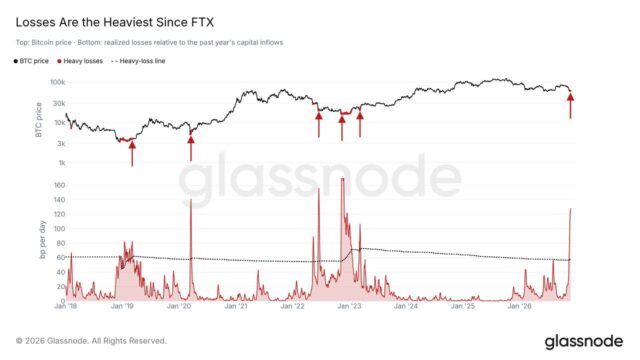
The financial pressure extends well beyond Bitcoin’s largest holders. Data from Glassnode shows that realized losses relative to capital inflows over the preceding year have reached their heaviest levels since the FTX collapse in 2022. Similar periods of market capitulation have occurred near previous cycle lows, although such readings alone are not enough to confirm that Bitcoin has bottomed.
What Needs to Happen for Bitcoin to Recover?
One of the biggest obstacles remains institutional fund demand.
As NewsBTC previously reported, persistent withdrawals from US spot Bitcoin ETFs have weakened the case for a sustainable recovery.
Figures from Farside Investors put Wednesday’s net outflows at $453 million, with BlackRock’s IBIT accounting for $329.7 million. Friday’s figures had yet to be confirmed when this article was prepared.
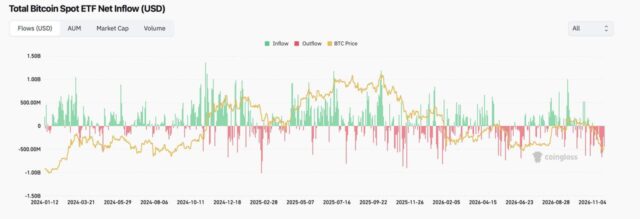
The longer-term picture from CoinGlass shows how Bitcoin ETF flows have changed during the market downturn. Recent trading sessions have been dominated by withdrawals, in contrast to the substantial inflows recorded during earlier stages of the rally.
A return to consistent ETF inflows would provide some evidence that demand is improving beyond the large wallets identified by CryptoQuant.
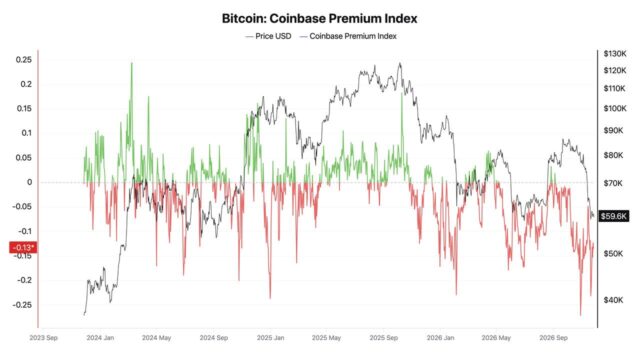
Another indicator worth watching is the Coinbase Premium Index, which measures the relative difference between Bitcoin prices on Coinbase and Binance.
The latest reading stands at approximately negative 0.13%, suggesting that buying pressure on Coinbase remains weak relative to Binance. A sustained return to positive territory, particularly alongside renewed ETF inflows, would strengthen the case for a recovery in US market demand.
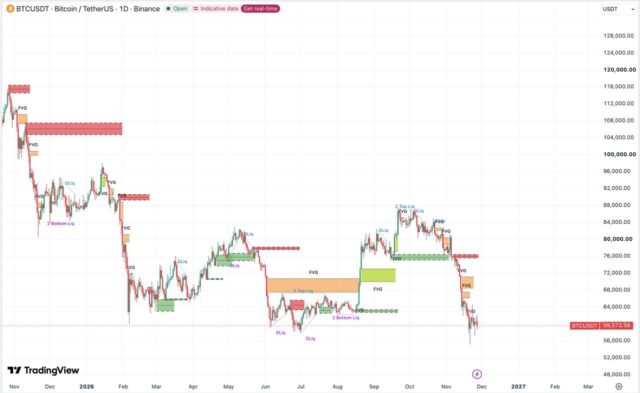
From a technical perspective, Bitcoin’s daily chart offers little confirmation that a sustainable recovery is underway. BTC continues to form lower highs and lower lows, with its latest decline taking the price below $60,000.
The immediate challenge is reclaiming the $63,000 to $64,000 region, followed by a more significant resistance area between $68,000 and $71,000. A sustained move above these levels would strengthen the case for a recovery.
On the downside, the recent low near $55,000 remains an important level to watch. A break below it could expose Bitcoin to further losses and undermine expectations of a year-end recovery.
For now, the conditions for a recovery are beginning to emerge in parts of the market, but there is little evidence that buying pressure has become strong enough to reverse the broader decline.
Could Bitcoin Recover Before 2027?
A recovery before the end of the year remains possible, particularly if selling pressure eases and institutional fund flows turn positive.
However, recovering from the recent lows and returning to previous all-time highs are two very different propositions.
The latest whale data makes a stronger case for the former than the latter. It suggests that some large holders are rebuilding their exposure during a period of considerable market stress, but it does not establish that Bitcoin has reached its bottom.
Investors looking for confirmation should pay less attention to isolated price rallies and more attention to whether demand is improving across multiple parts of the market.
Bitcoin may be getting cheaper for long-term investors, but being cheap and being ready to recover are not necessarily the same thing.
from Bitcoinist.com https://ift.tt/MeA9Y7v
Comments
Post a Comment