Zcash’s sharp revival did not happen by accident, according to Josh Swihart, who argues that ZEC’s roughly 1,500% rally reflects a multi-year reset across governance, product strategy, narrative positioning and organizational structure. In a detailed update, Swihart framed Zcash’s recent strength as the result of hard decisions made in 2023 and 2024 that are now compounding across the ecosystem.
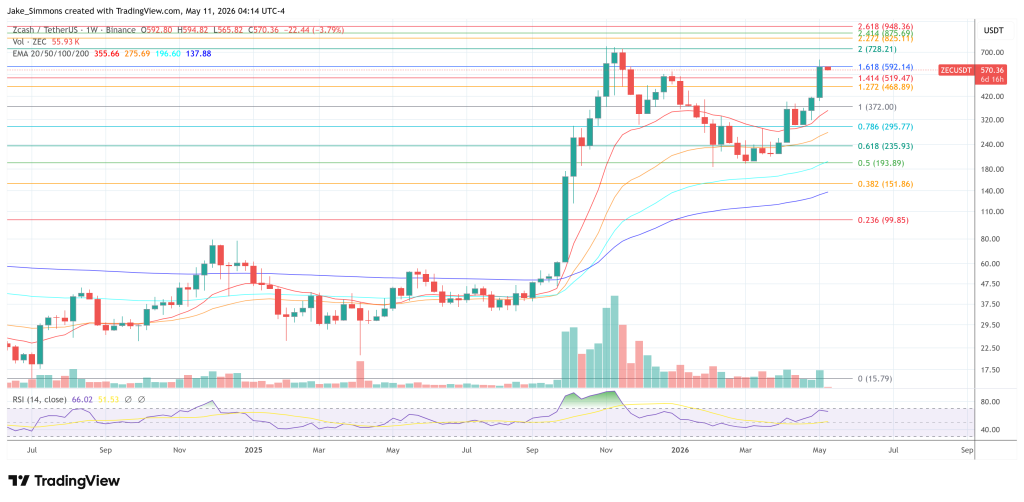
Three years ago, Swihart said, Zcash had strong cryptography but weak momentum. ZEC was trading around $30, less than 11% of supply was shielded, and community discussion was dominated by governance disputes. Today, he said, ZEC is around $600, roughly 31% of supply is shielded, more than $3 billion in value is held in user-controlled shielded wallets, and shielded transactions reached 86.5% in mid-March.
“Nothing happens by chance,” Swihart wrote. “Here were the unlocks and why growth is accelerating.”
Governance Reset Becomes Central To The Zcash Story
Swihart’s first explanation centers on governance. For Zcash’s first eight years, 20% of every block reward went to the same core institutions, later including Zcash Community Grants. In his view, that created an incumbency problem: organizations had guaranteed funding while also holding significant influence over protocol direction.
That changed in 2024, when Electric Coin Co. announced it would not accept direct funding. Swihart said the decision forced the legacy model to break. Network Upgrade 6 then cut direct funding and redirected 8% to Zcash Community Grants, while sending 12% into a protocol-controlled lockbox intended for ZEC holders to retroactively distribute grants to contributors delivering measurable value. Both streams expire at the end of the third halving in late 2028 unless renewed by overwhelming community consensus.
The trademark issue also mattered. Swihart said ECC’s August 2024 notice to terminate the trademark agreement, followed by the Zcash Foundation’s decision not to use the trademark for governance, ended a structure in which ECC and ZF held effective veto power over the protocol.
“The stranglehold on Zcash governance was broken, and coin holders and other groups across the ecosystem were able to be heard,” he wrote. “No single body, including the ZF’s ZCAP, has a monopoly on determining community sentiment. Zcash was finally set free.”
Zodl And Shielded Usage Put Product Back In Focus
The second shift was product. Swihart said ECC reoriented in January 2024 toward user adoption after years in which technical work produced strong privacy infrastructure but limited user growth. By 2023, he said, the community was contracting, X sentiment was heavily negative or neutral, and a ZURE survey showed ZEC holders had an NPS score of -60.
Zashi, later rebranded as Zodl, became the clearest expression of that shift. The wallet launched in March 2024 with shielded-by-default usage, hardware wallet support and token swaps. Swihart said shielded supply rose from about 11% to about 30% by the end of 2025, a more than 400% increase in absolute ZEC terms, while the wallet processed more than $600 million in ZEC swaps since October.
He emphasized that this activity was not simply exchange inventory or passive treasury accumulation. “These are real people choosing privacy and holding their own keys,” Swihart wrote.
Swihart also argued that Zcash had a narrative problem. The “privacy coin” label, he said, placed ZEC into a category associated with delistings, regulatory scrutiny and institutional hesitation, while obscuring the actual proposition: opt-in shielded payments, Bitcoin-style monetary policy and verifiable private transactions.
He said the new framing around “unstoppable private money” has made ZEC more legible to allocators and infrastructure providers. Swihart cited Robinhood’s listing, Multicoin disclosing a position, Grayscale’s ETF filing and Foundry launching a Zcash mining pool as examples of wider access and institutional engagement.
ZODL Raises $25 Million As Scaling And Quantum Work Advance
The organizational reset came in January 2026, when Swihart said the ECC team left to form Zcash Open Development Lab, or ZODL, after a dispute with Bootstrap’s board. He argued that Zcash needed startup-style capital and speed to build consumer products at scale.
ZODL has since closed a $25 million round backed by Paradigm, a16z crypto, Winklevoss Capital, Coinbase Ventures, Cypherpunk Technologies, Chapter One, Balaji Srinivasan and others. Swihart described the round as a strong signal for the team’s mission to scale Zcash adoption.
Near-term priorities now include UX, scalability and post-quantum readiness. Swihart said Zodl is working on better performance, more swap options, on- and offboarding, in-app coin-holder polling and requested user features. On scalability, Zcash is targeting 25-second block times, down from 75 seconds, while Tachyon aims to restructure the protocol around stateless wallets carrying recursive zero-knowledge proofs.
“Net, Zcash will be faster, easier to use, more feature-rich, more scalable, and post-quantum secure,” Swihart concluded.
At press time, ZEC traded at $570.36.
from Bitcoinist.com https://ift.tt/f5PNOk3
Comments
Post a Comment