The crypto market is facing volatility and uncertainty as the US-Israel-Iran conflict continues to develop. Markets are reactive. Capital is cautious. And an XWIN Research Japan report has just added a dimension to the current risk landscape that has nothing to do with geopolitics — and everything to do with what happens to crypto users when attention is elsewhere.
The FBI’s 2025 fraud data reveals a number that demands to be read in full: crypto-related losses reached $11.3 billion last year — the largest single fraud category in federal law enforcement reporting. Investment scams alone accounted for $8.6 billion. Romance scams, impersonation schemes, and tech support fraud completed the picture, each one using crypto as the payment rail of choice precisely because of the properties that make it valuable — irreversibility, pseudonymity, and instant settlement.
The demographic data removes any comfort in the idea that scams target only the unsophisticated. Those aged 60 and above suffered approximately $4.4 billion in losses, the largest single age group. But victims span every demographic. The common thread is not naivety. It is structural: once a crypto transaction is sent, it cannot be recalled.
In a volatile market where attention is consumed by geopolitical risk, the $11.3 billion figure is a reminder that the threat to crypto participants does not always come from the chart.
The Market Is Moving Toward Freedom. Freedom Has a Cost
The XWIN Research Japan analysis identifies a structural shift that runs parallel to the fraud surge — and makes it more consequential, not less. On-chain data shows persistent outflows from exchanges as users move assets into self-custody wallets.
Institutional custody strategies, long-term holding conviction, and rising awareness of counterparty risk are all contributing to the same directional behavior: coins leaving platforms and entering wallets where only the holder controls the keys.
Ethereum makes the trend most visible. Smart contract deployments continue to grow, reflecting real and expanding usage across DeFi, NFTs, and stablecoin payment infrastructure. Ethereum’s architecture is built around direct wallet interaction — every meaningful on-chain action requires a user to sign with their own key. The network is not just accommodating self-custody. It is structurally designed around it.

The paradox the report names is precise and uncomfortable. Scams are at record levels. Network usage is expanding. Assets are leaving exchanges. These three developments are happening simultaneously — and they are not contradictory. They are the same story told from different angles. More users are taking direct control of their assets at exactly the moment when the consequences of a single mistake or a single scam are permanent and irreversible.
Self-custody is not a safety upgrade. It is a responsibility transfer. In a market where $11.3 billion was lost to fraud last year, that transfer is not trivial — it is the most important risk decision a crypto participant currently makes. Price will recover from a drawdown. A compromised wallet does not.
Total Crypto Market Cap Stabilizes
The total crypto market cap is currently consolidating around $2.4 trillion after a sharp rejection from the $3.8–$4.1 trillion region, marking a clear loss of momentum from the 2025 expansion phase. The weekly structure shows a transition from a strong uptrend into a corrective environment, with price now trading below the 50-week (blue) and testing the 100-week (green) moving average.
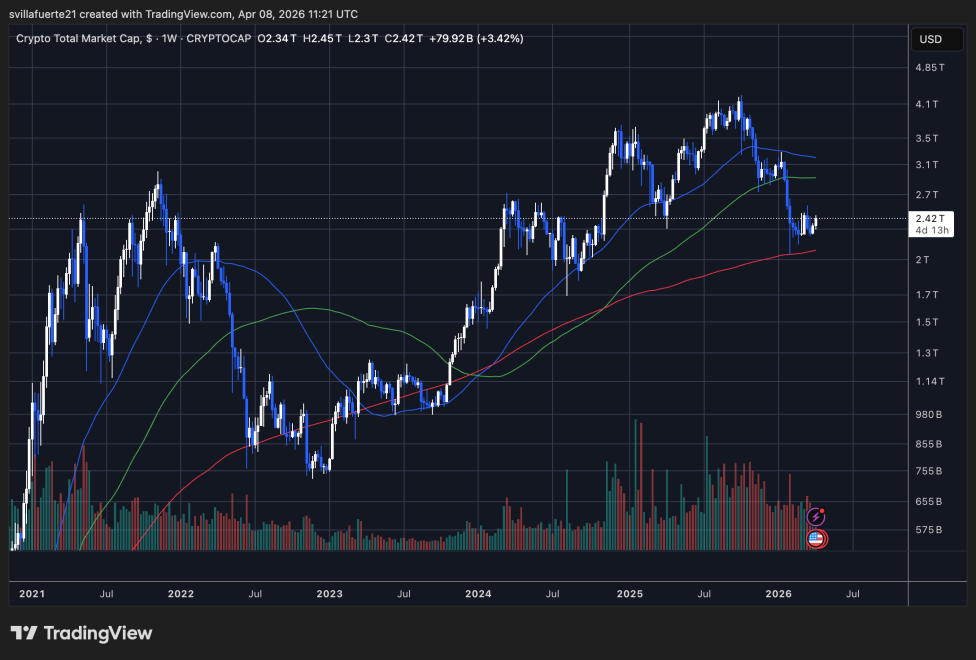
The rejection from the highs was accompanied by a notable increase in volume, signaling distribution rather than a low-liquidity pullback. Since then, price action has compressed, forming a tentative base just above the 200-week moving average (red), which continues to trend upward. This level now acts as the primary macro support defining whether the broader cycle structure remains intact.
Short-term attempts to reclaim the 50-week moving average have repeatedly failed, indicating that upside momentum remains weak. However, the absence of continued aggressive selling suggests that the market is not in capitulation but in equilibrium.
This zone is structurally important. A sustained hold above current levels would support a continuation of the higher timeframe uptrend. A breakdown below the 200-week moving average, however, would signal a deeper cycle reset, shifting the market from correction into contraction.
Featured image from ChatGPT, chart from TradingView.com
from Bitcoinist.com https://ift.tt/CJXGV4x
Comments
Post a Comment