Bitcoin surged above $72,000 yesterday and is holding above $70,000 today. The narrative of a bottom is building. And an XWIN Research Japan analysis is asking the more important question: not whether Bitcoin has bounced, but whether anyone understands why it fell.
The report from XWIN Research Japan reframes the past six months in a way that changes how the current recovery should be read. Bitcoin is not, in their framework, a standard risk asset that rises and falls with market sentiment. It is a terminal liquidity asset — the last recipient in a hierarchical financial system where capital flows from central banks to government bonds to equities and finally, at the very end of the chain, to crypto. When the upstream flow weakens, Bitcoin does not experience demand destruction. It receives nothing. The capital simply never arrives.
That is what happened over the past six months. Elevated US interest rates, a strengthening dollar, and rising Japanese bond yields simultaneously tightened global liquidity from multiple directions. Japan — one of the largest external investors in global markets — reduced its capital exports as domestic bond yields made home markets more attractive. The result was not investors selling Bitcoin. It was investors who never bought it.
The bounce above $72,000 is visible. Whether the conditions that prevented the capital from arriving have changed is the question the price chart cannot answer.
The Sell-Off Was Not Spot. It Was Credit
The analysis adds the second layer that completes the structural picture. As global liquidity tightened and capital stopped reaching Bitcoin, the derivatives market compounded the damage through a mechanism separate from — and more destructive than — simple selling.
Excess leverage accumulated during the bull run began unwinding in cascading liquidations. Each forced exit consumed demand that would have entered the market in future sessions. The downside was not just the selling that happened. It was the buying that was destroyed before it could occur.
The on-chain data confirms this interpretation without contradicting it. STH-SOPR holding below 1.0 for sustained periods reflected short-term holders realizing losses — an outcome of the liquidity squeeze, not its cause. The Coinbase Premium Gap staying negative reflected weak US spot demand — again, an outcome. These indicators describe what was happening to participants at the retail level while the structural cause operated several layers above them in the global capital hierarchy.

The forward conditions are equally structural and equally precise. A new all-time high requires capital to flow back through the system — from central banks, through bonds, through equities, and finally to the terminal edge where Bitcoin waits. Two catalysts could accelerate that flow specifically: US midterm elections influencing fiscal expansion and rate expectations, and a potential Japan Bitcoin ETF that would open access to one of the largest pools of household savings in the world.
The past six months were not a verdict on Bitcoin. They were a consequence of where it sits in the financial system. The next major move will arrive when the system above it changes — not when the narrative does.
Bitcoin Reclaims $70K but Trend Structure Remains Unresolved
Bitcoin has pushed back above the $70,000 level after a sharp recovery from its February lows, but the broader structure remains technically fragile. The chart still reflects a clear downtrend sequence from late 2025, with price consistently trading below the 100-day (green) and 200-day (red) moving averages. Both remain downward sloping, indicating that the macro trend has not yet shifted despite the recent bounce.
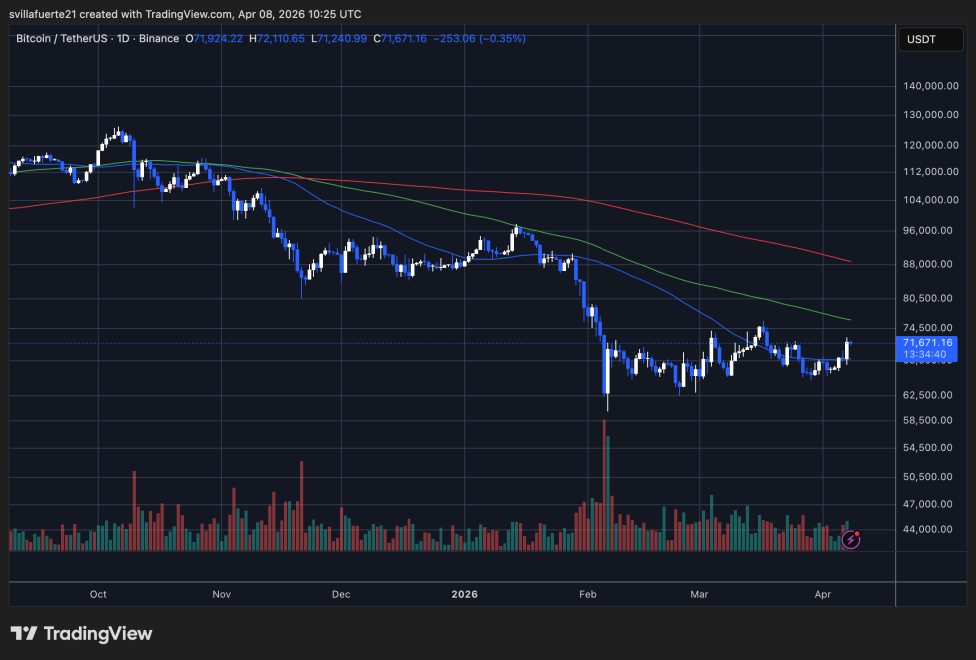
The February capitulation event marked a local exhaustion point, with a spike in volume and a rapid wick below $60,000, followed by stabilization. Since then, the price has formed a range between roughly $62,000 and $72,000, with multiple failed attempts to sustain a breakout above resistance. The recent move above $70,000 is notable, but it has not yet been accompanied by a decisive expansion in volume or follow-through.
Short-term momentum has improved, as Bitcoin is now testing the 50-day moving average (blue), but this level has acted as dynamic resistance throughout the downtrend. A confirmed reclaim of this zone would be the first structural signal of strength. Until then, the current move appears corrective within a broader bearish framework, not a confirmed trend reversal.
Featured image from ChatGPT, chart from TradingView.com
from Bitcoinist.com https://ift.tt/gHMITtD
Comments
Post a Comment