Bitcoin is holding above $76,000 as the market tests resistance and the broader environment remains uncertain. The price is constructive, but the forces operating beneath it tell a more complicated story — and top analyst Darkfost has identified a signal in the Hash Ribbons that adds a specific layer of structural context to where Bitcoin stands right now.
The Hash Ribbons is an indicator that functions as a barometer of miner activity, comparing the 30-day and 60-day moving averages of Bitcoin’s hashrate to identify when mining operations are genuinely under stress. Understanding why that reading matters requires a brief look at the economics pressing on miners right now.
Today’s block reward is 3.125 BTC — a number that sounds meaningful at current prices but represents a fraction of the 50 BTC that early miners received per block. The dollar value of that reward has grown enormously over time, but so has the cost and complexity of earning it.

Rising mining difficulty demands increasingly efficient and expensive hardware. Energy costs remain high and volatile. Fixed operational expenses do not adjust when prices fall. Infrastructure disruptions — from weather events to geopolitical pressures on energy markets — can force shutdowns that have nothing to do with Bitcoin’s underlying health.
When these pressures stack simultaneously, miners face a choice: scale back, find efficiencies, or capitulate. The Hash Ribbons are what make that choice visible in the data — and right now, it is signaling something that demands attention.
The Signal Is Real. The Question Is What Caused It.
The Hash Ribbons is built to detect a specific sequence. When mining becomes unprofitable enough that operators are forced to shut down machines, hashrate falls. As hashrate falls, difficulty eventually adjusts lower, improving the economics for the miners who survived. Forced selling eases. Machines come back online. Network conditions normalize. That recovery phase — the transition from capitulation to stabilization — is where the Hash Ribbons has historically identified some of Bitcoin’s most asymmetric entry points.

The current signal fits that pattern on the surface. But Darkfost’s caution is grounded in a precedent that occurred earlier this year. When ice storms forced temporary miner shutdowns across parts of the United States, the Hash Ribbons fired a buy signal that had nothing to do with genuine capitulation.
The hashrate drop was weather-driven, not economics-driven. The difficulty adjustment that followed reflected a temporary infrastructure disruption rather than the kind of sustained stress that historically precedes meaningful recoveries. Similar false signals appeared during China’s mining ban in 2021 and in June 2022.
The pattern has not broken. But the signal has become harder to read cleanly. With block rewards at 3.125 BTC and shrinking every four years, mining operations are increasingly sensitive to external shocks — geopolitical tensions affecting energy markets, supply chain disruptions affecting hardware, weather events affecting infrastructure. Each of these can trigger the same hashrate decline that genuine capitulation produces, without the same underlying conditions that make that capitulation a meaningful buying opportunity.
Hash Ribbons flashing a buy signal is significant. Understanding whether miners stopped because they had to or because they were forced to by something external is the distinction that determines whether the signal should be trusted or treated with caution.
Bitcoin Reclaims Range but Faces Overhead Resistance
Bitcoin is trading near $77,500 on the weekly chart, recovering from the sharp breakdown that followed the rejection near $120,000. The recent structure shows a stabilization phase after the capitulation into the $62,000–$65,000 demand zone, where strong buying interest previously entered the market. That area now stands as a confirmed macro support.
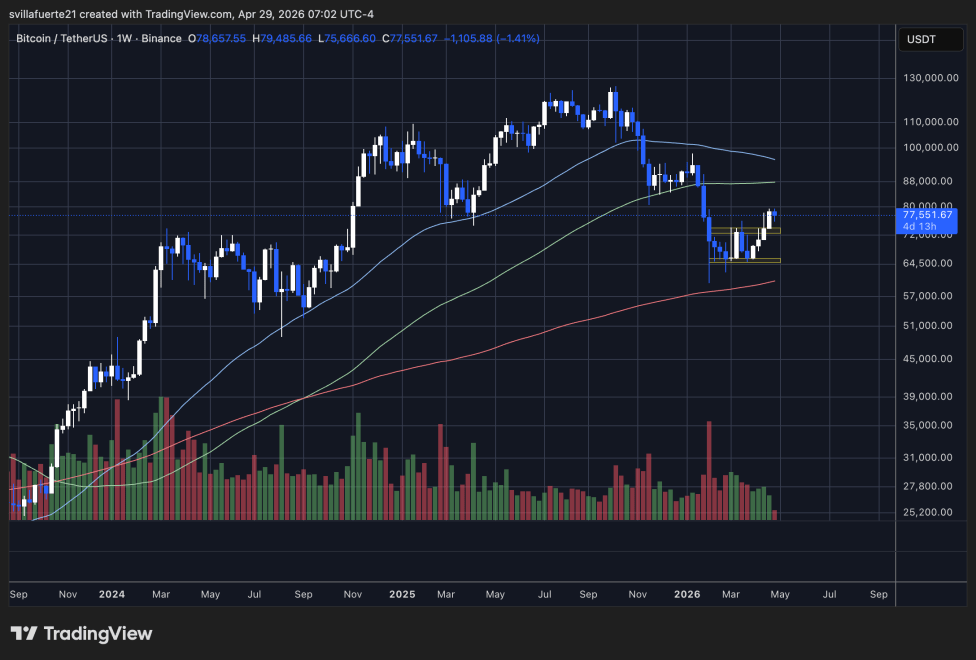
The current recovery has pushed prices back above the $70,000–$74,000 range, which had acted as resistance during March. This reclaim is technically constructive and suggests the market has absorbed a portion of the prior selling pressure. However, the recovery is now approaching a more complex resistance cluster.
The 50-week and 100-week moving averages are converging between $80,000 and $90,000, creating a dense supply zone overhead. These levels previously acted as support during the uptrend and are now likely to function as resistance. The slope of these averages has flattened, indicating the trend is transitioning rather than trending cleanly.
Volume confirms the shift in regime. The capitulation phase showed elevated participation, while the recovery has developed on lower volume, suggesting a more cautious re-entry of buyers.
Featured image from ChatGPT, chart from TradingView.com
from Bitcoinist.com https://ift.tt/51TGgNs
Comments
Post a Comment