Bitcoin is struggling to hold above $70,000. Days of trying to defend $65,000 have given way to a fragile recovery that the market does not yet trust. A top CryptoQuant analyst has identified the structural reason why — and it has nothing to do with sentiment, ETF flows, or macroeconomic headlines.
The culprit is in the mining data. A CryptoQuant analysis examining the relationship between Miner Selling Power and Bitcoin’s price has identified a decoupling that began in the second half of 2025 and has been widening ever since. Historically, the two indicators moved in correlation — when Bitcoin price rose, miners’ selling power declined as profitability improved, and vice versa. That relationship has broken down entirely.
What the chart now shows is a divergence that runs in the wrong direction: Miner Selling Power is sharply rising while Bitcoin’s price falls. The miners who are supposed to benefit from a recovery are instead increasing their selling activity into weakness. That is not profit-taking. That is survival.
The connection to the stagnant hashrate data is direct and confirming. Miners are not expanding. They are not holding. They are selling — not because the market is giving them a reason to, but because the alternative is shutting down.
This Is Not Capitulation. It Is Something More Dangerous
The report’s conclusion reframes what is happening in the mining industry in a way that changes how the current Bitcoin market should be read. The word capitulation implies a single event — a moment of peak pain where the last forced sellers exit simultaneously, clearing the market and establishing a floor. What the Miner Selling Power data describes is not that. It is a continuous, sustained, survival-driven unloading that has no defined endpoint because its trigger is not sentiment — it is the ongoing gap between operating costs and revenue.

Miners facing a harsh profitability winter do not sell because they have lost conviction in Bitcoin. They sell because electricity bills, hardware maintenance, and facility costs arrive on a schedule that the Bitcoin price does not respect. Every week that production costs exceed mining revenue is another week of forced selling — regardless of where price stands, regardless of what the chart suggests, regardless of what the broader market is doing.
That persistence is what makes the current overhead so structurally significant. It is not a wall of supply waiting for the right price to clear. It is a drip of forced selling that the market must absorb continuously before any sustained upside can develop.
The analyst’s forward position is stated without ambiguity: upside potential remains limited until these survival-driven sell-offs are fully absorbed. Until that absorption is confirmed in the data, the conservative perspective is not caution — it is the only analytically defensible posture available.
Bitcoin Stalls Below Resistance as Downtrend Persists
Bitcoin is trading near $66,800, continuing to consolidate after the sharp February breakdown that disrupted its prior bullish structure. The chart shows a clear shift in trend, with price moving from a series of higher highs into a pattern of lower highs and lower lows, confirming sustained bearish pressure.
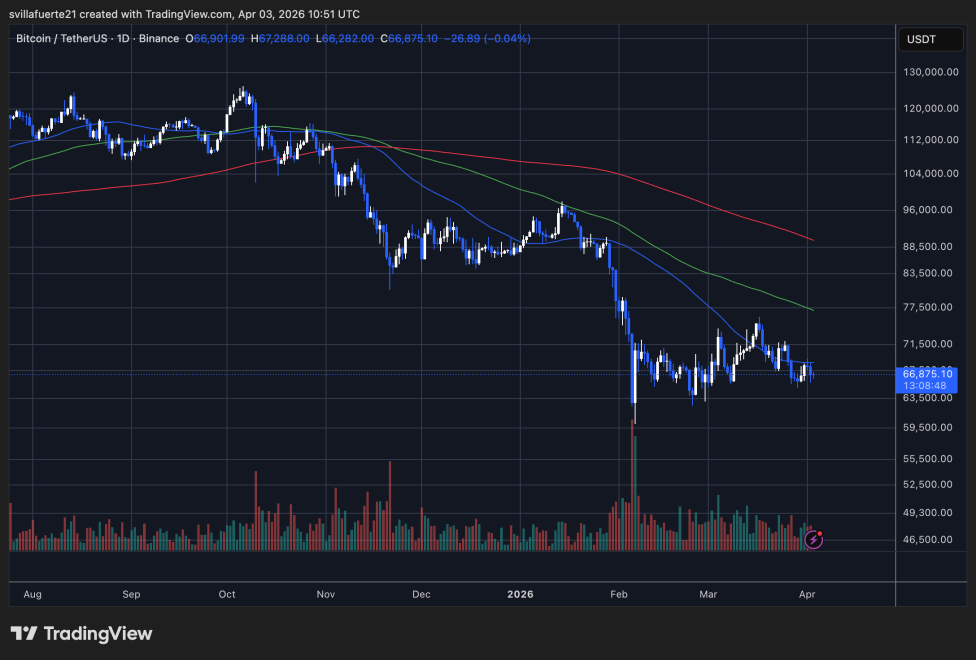
Following the capitulation event — marked by a significant spike in volume — BTC entered a range between approximately $62,000 and $72,000. Since then, price action has remained contained within this zone, but with a noticeable bias toward the lower end, suggesting weakening demand.
The 50-day and 100-day moving averages are both trending downward above price, acting as dynamic resistance and limiting any recovery attempts. The 200-day moving average remains far above current levels, reinforcing the broader structural shift from expansion to correction.
Recent rallies toward the $70,000–$72,000 region have consistently failed, producing lower highs and indicating that sellers are still active on strength. Volume has declined during consolidation, pointing to reduced participation and a lack of strong conviction from buyers.
Unless Bitcoin can reclaim key moving averages and break above range resistance with strength, the current structure favors continued consolidation or a potential move lower toward support.
Featured image from ChatGPT, chart from TradingView.com
from Bitcoinist.com https://ift.tt/e5ryGMU
Comments
Post a Comment