
Bitcoin Difficulty To Rise 14% Thursday—Why The Massive Jump?

On-chain data shows the Bitcoin network Difficulty is set for a significant jump in the upcoming adjustment. Here’s what’s behind it.

Bitcoin Difficulty To Go Up Massively In Thursday’s Adjustment

The Bitcoin “Difficulty” is a feature built into the blockchain that controls how hard miners will find it to mine a block on the network. The feature exists to limit the speed at which these chain validators can earn mining rewards.

Satoshi coded in a simple rule for the network to follow: keep the block production rate constant at 10 minutes per block. Whenever miners are producing the average block in an interval faster than 10 minutes, the blockchain raises its Difficulty to bring them back to the standard rate. Similarly, them being slow forces the network to ease the metric instead.

Changes in the Difficulty occur about every two weeks in events known as adjustments. The upcoming such event happens to be tomorrow, February 19th. Below are the details related to this adjustment from CoinWarz.
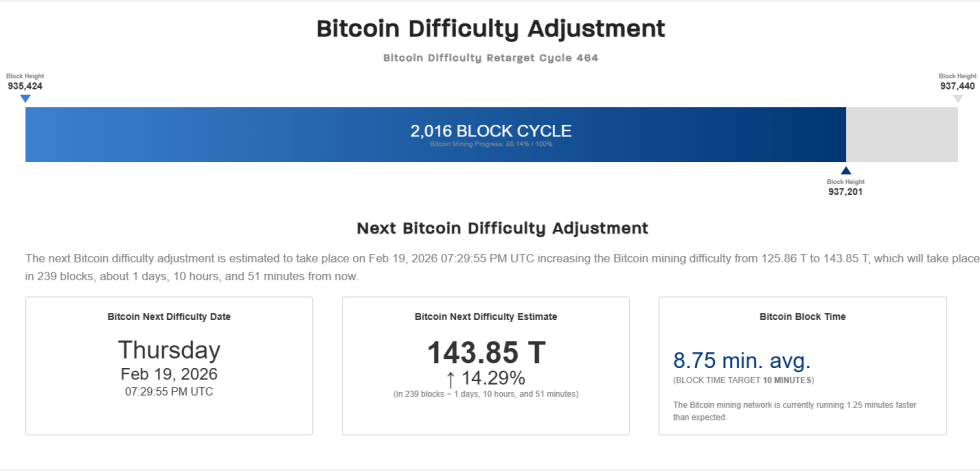
Bitcoin Difficulty

As is visible, the average block time on the Bitcoin network has stood at 8.75 minutes since the previous adjustment, meaning that miners have been significantly faster than usual.

As a result of this fast pace, the network is estimated to raise its Difficulty by more than 14% on Thursday. This is an unusually big jump for the indicator, and the reason behind it lies in equally unusual circumstances.

In late January, a massive snow storm swept across the United States, causing disruptions to the nation’s infrastructure, including the electrical grid. As a response to the extreme weather event, Bitcoin miners situated in the country curtailed their power to help ease pressure on the grid.

Foundry USA, the world’s largest BTC mining pool, saw a notable drop of nearly 60% in its total computing power or “Hashrate” as miners pulled back. The drop in the global Hashrate was so drastic that the Difficulty adjustment that followed led to an easing of about 11%.

However, while the Hashrate decline was dramatic, it was never gonna be something permanent. As the below chart for the 7-day average Hashrate from Blockchain.com shows, the indicator has already recovered back to about the same level as on January 24th, before the snow storm took American mining machines offline.

Bitcoin Mining Hashrate

The Bitcoin network had reduced its Difficulty based on the speed miners were operating at due to the reduced US capacity, but as the Hashrate has bounced back, the blockchain is now forced to correct the metric in the other direction.

BTC Price

Bitcoin has continued to move sideways recently as its price is still trading around $67,600.

Bitcoin Price Chart


from Bitcoinist.com https://ift.tt/jsq86cg

Comments

Popular posts from this blog

Dogecoin Sees 47% Spike In Active Addresses, Why Price Could Follow Suit

Dogecoin has witnessed a massive spike in its active addresses , providing a bullish outlook for the foremost meme coin. Based on this development, the DOGE price could also witness a bullish reversal soon enough as it reclaims key support levels.  Dogecoin Records 47% Spike In Active Addresses In an X post , crypto analyst Ali Martinez stated that Dogecoin’s network activity is picking up. This came as he revealed that active addresses have jumped 47% in the past month, rising from 110,000 to 163,000. This development is bullish as it indicates more users are using the network.  This could help spark a significant rally in the Dogecoin price, as a surge in active addresses indicates that DOGE’s utility is on the rise. Another onchain metric which paints a bullish picture for the meme coin and hints at a reversal is the increase in new addresses. In another X post, Martinez revealed that Dogecoin’s new addresses have doubled in the past month, climbing from 16,400 to 34,6...

Bitcoin ETFs Post Second Straight Week Of $500 Million Outflow — Details

The US-based spot Bitcoin ETFs (exchange-traded funds) recorded their second consecutive week of significant outflows over the last five-day trading period. This recent run of disappointing performances reflects the ongoing shift in investor sentiment in the United States. Over the past year, strong inflows into the US Bitcoin ETF market have constantly been associated with positive action for the BTC price. Fittingly, the price of Bitcoin has been consolidating over the past few weeks, struggling to pick up any real momentum. Bitcoin ETFs Record Fourth Consecutive Outflow Day According to the latest market data , the US Bitcoin ETFs registered a total daily outflow of $62.77 million on Friday, February 21. This latest round of withdrawals marked the fourth straight day (and the eighth day in the last nine trading days) that the crypto-based products would witness a net capital outflow. The Grayscale Bitcoin Trust (with the ticker GBTC) accounted for a larger percentage of Friday’...

Bank of Russia Proposes Limited Crypto Trading for Select Investors

The Bank of Russia has put forward a new proposal that could mark a significant shift in the country’s approach to cryptocurrency regulation. Earlier today, the central bank announced that it has submitted a proposal to the Russian government to discuss allowing a limited group of investors to buy and sell cryptocurrencies such as Bitcoin. The proposal suggests implementing a three-year experimental regime where only qualified investors with at least $1.1 million in securities and deposits would be permitted to engage in crypto trading. This move is part of ongoing efforts to define Russia’s digital currency policies, which have historically shifted between strict regulations and cautious acceptance. Despite considering this controlled legalization for select investors, the Bank of Russia maintains its stance against using cryptocurrency as a payment method. The institution has also recommended introducing penalties for those who violate the terms of the experimental regime, rein...