Analyst Predicts When The Bitcoin Supercycle Will Actually Begin

A crypto analyst is pushing back against growing narratives around the Bitcoin supercycle, arguing that BTC’s biggest breakout is yet to arrive. He has revealed when the real supercycle will begin, centering his bullish thesis on a generational shift in capital, where BTC potentially overtakes traditional safe-haven assets like Gold as the preferred long-term store of value.

The “Real” Timeline For The Bitcoin Supercycle

On December 27, crypto market expert Killa shared a new long-term thesis on X that challenges the popular bullish expectations for BTC this cycle. He argues that countless traders have prematurely declared the start of the Bitcoin supercycle without understanding what truly triggers one. 

According to Killa, the real supercycle does not begin simply because Bitcoin rises in price or outperforms short-term expectations. Instead, he explained that a genuine supercycle starts only when capital structurally rotates away from precious metals and into BTC. 

The analyst emphasized that Gold must first enter a sustained multi-year downtrend while Bitcoin simultaneously absorbs flows and breaks into new highs driven by “absolute scarcity.” In his view, this moment represents a decisive shift in which older capital remains parked in Gold while newer-generation capital moves into a fresh asset class. 

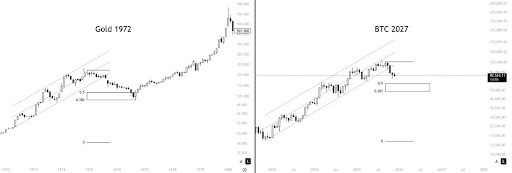
Supporting his bullish thesis, Killa compared Gold in 1972 to where Bitcoin may be heading into 2027. The analyst presented a chart showing Gold consolidating after a strong advance, then pulling back into key retracement zones before launching into an explosive multi-year rally that grossly outperformed other major asset classes

Bitcoin

Killa noted that Bitcoin’s structure is almost identical to Gold’s historical setup from this time, with price trending inside a rising channel and recently pulling back from the upper boundary. The chart highlights similar retracement levels that suggest consolidation rather than trend failure, reinforcing the analyst’s belief that Bitcoin may end up outpacing every asset class in the next cycle. 

Also, the analyst placed strong emphasis on market capitalization to frame BTC’s upside potential. He pointed out that even if Bitcoin were to climb to $200,000, its market cap would still be roughly six times smaller than Gold’s. With Gold valued at approximately $31.7 trillion and Bitcoin at around $1.83 trillion, the disparity leaves more room for BTC’s price to grow in the future. 

BTC’s Next Surge Could Begin Amid Rising Fear

In the same post, Killa warned that new market fears have emerged, shaking investor confidence. He has stated that quantum computing and Artificial Intelligence (AI) are the latest concerns, following previous worries about regulation, energy use, and market volatility.

The analyst expects this fear to push many participants out of the market just before Bitcoin’s major move begins. He believes this cycle may be the last opportunity to accumulate BTC below $100,000, signaling a potential end to prolonged bear market conditions. Despite the risks of a continued downtrend, Killa has revealed that he plans to continue buying BTC, predicting a decisive upward trend soon.

Bitcoin

from Bitcoinist.com https://ift.tt/UxQf06T

Comments

Popular posts from this blog

Dogecoin Sees 47% Spike In Active Addresses, Why Price Could Follow Suit

Dogecoin has witnessed a massive spike in its active addresses , providing a bullish outlook for the foremost meme coin. Based on this development, the DOGE price could also witness a bullish reversal soon enough as it reclaims key support levels.  Dogecoin Records 47% Spike In Active Addresses In an X post , crypto analyst Ali Martinez stated that Dogecoin’s network activity is picking up. This came as he revealed that active addresses have jumped 47% in the past month, rising from 110,000 to 163,000. This development is bullish as it indicates more users are using the network.  This could help spark a significant rally in the Dogecoin price, as a surge in active addresses indicates that DOGE’s utility is on the rise. Another onchain metric which paints a bullish picture for the meme coin and hints at a reversal is the increase in new addresses. In another X post, Martinez revealed that Dogecoin’s new addresses have doubled in the past month, climbing from 16,400 to 34,6...

Bitcoin ETFs Post Second Straight Week Of $500 Million Outflow — Details

The US-based spot Bitcoin ETFs (exchange-traded funds) recorded their second consecutive week of significant outflows over the last five-day trading period. This recent run of disappointing performances reflects the ongoing shift in investor sentiment in the United States. Over the past year, strong inflows into the US Bitcoin ETF market have constantly been associated with positive action for the BTC price. Fittingly, the price of Bitcoin has been consolidating over the past few weeks, struggling to pick up any real momentum. Bitcoin ETFs Record Fourth Consecutive Outflow Day According to the latest market data , the US Bitcoin ETFs registered a total daily outflow of $62.77 million on Friday, February 21. This latest round of withdrawals marked the fourth straight day (and the eighth day in the last nine trading days) that the crypto-based products would witness a net capital outflow. The Grayscale Bitcoin Trust (with the ticker GBTC) accounted for a larger percentage of Friday’...

Bank of Russia Proposes Limited Crypto Trading for Select Investors

The Bank of Russia has put forward a new proposal that could mark a significant shift in the country’s approach to cryptocurrency regulation. Earlier today, the central bank announced that it has submitted a proposal to the Russian government to discuss allowing a limited group of investors to buy and sell cryptocurrencies such as Bitcoin. The proposal suggests implementing a three-year experimental regime where only qualified investors with at least $1.1 million in securities and deposits would be permitted to engage in crypto trading. This move is part of ongoing efforts to define Russia’s digital currency policies, which have historically shifted between strict regulations and cautious acceptance. Despite considering this controlled legalization for select investors, the Bank of Russia maintains its stance against using cryptocurrency as a payment method. The institution has also recommended introducing penalties for those who violate the terms of the experimental regime, rein...