A recent survey found that Ukrainians are focusing on diversifying their investment strategies as their trust in the traditional financial system weakens, turning to Bitcoin (BTC) and other cryptocurrencies for savings and investments.
Ukrainians Turn To Bitcoin For Financial Security
A survey conducted by Ipsos and commissioned by crypto exchange WhiteBIT revealed that Ukrainians no longer perceive traditional financial models as the most reliable option due to the ongoing war, inflation, currency fluctuations, and uncertainty.
The survey, conducted between April and May 2025, included 650 financially active respondents aged 18 to 65 living in cities with populations over 100,000, excluding temporarily occupied territories and active conflict zones.
The surveyed group consisted of 300 financially active adults who earn income, save money, and don’t reject investing in Bitcoin or other cryptocurrencies, as well as 350 respondents who already hold part of their savings in crypto.
According to the study findings, more than half of the respondents are focusing on diversification rather than conservatism, already considering or using alternative investment tools beyond traditional savings scenarios, such as cash and bank deposits.
Therefore, traditional savings tools are being complemented by new ones, the survey highlighted, with cryptocurrencies already among the most popular investment tools, alongside bank accounts and real estate.
Notably, cryptocurrencies like Bitcoin are gradually losing their status as “exotic,” ceasing to be solely a trading tool and becoming one of many financial strategies in the modern Ukrainian investor’s portfolio:
Common use cases include trading (57%), long-term asset storage (52%), protecting savings from inflation (51%), as well as daily financial transactions and transfers of funds (assets).
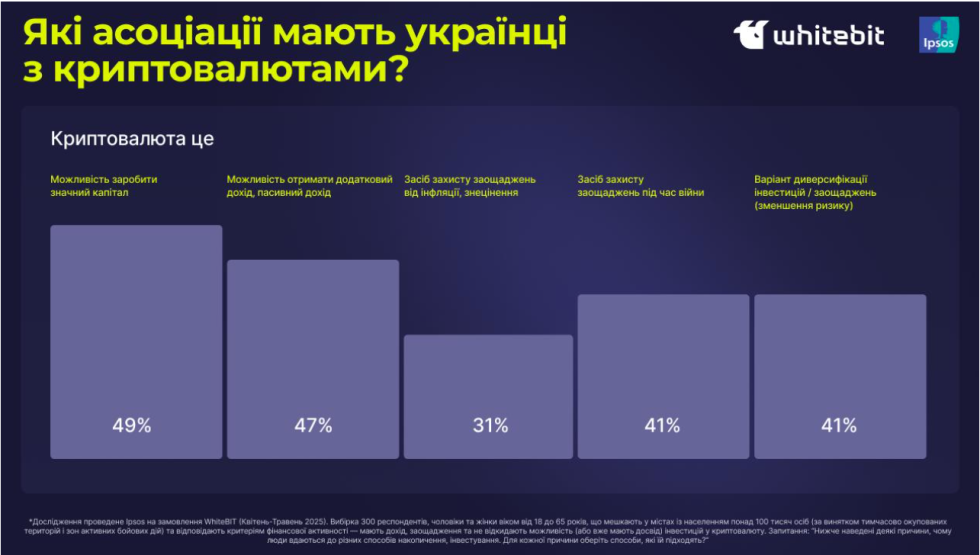
As the chart above shows, 49% of respondents consider digital assets to be an opportunity to earn significant capital, while 47% view crypto as an opportunity to earn additional or passive income. Meanwhile, 31% of the surveyed individuals view digital assets as a means of protecting savings from inflation, and 41% see them as a vehicle to safeguard savings from the war’s impact on the economy.
The survey also found that Ukrainian investors “are ready to take responsibility for their financial future” as they show a desire for financial independence and learning about the sector.
Citing experts, the survey noted that “in times of military instability, people are increasingly seeking tools that allow them to manage finances independently of the state or banking system.”
Similarly, a September report by the European Bank for Reconstruction and Development (EBRD) noted that Ukraine emerged as one of the leading crypto users as several economies in the EBRD regions continue to face high government interest payments as a share of GDP and/or high public debt.
According to the report, “the 2025 growth forecast for Ukraine has been revised down, as the impact of the ongoing Russian aggression has been compounded by weak harvests,” while the external sector has deteriorated.
Nonetheless, Ukraine stands out with one of the highest rates of cryptocurrency exposure, ranking among the top 10 economies globally for crypto adoption between July 2023 and July 2024.
During this period, Ukraine received over $106 billion in crypto inflows, driven mostly by institutional and professional transfers, and has spent $882 million worth of Ukrainian hryvnia on Bitcoin purchases.
Ukraine’s Crypto Landscape
It’s worth noting that Ukraine has received significant aid from the global community through Bitcoin and crypto donations since Russia’s invasion started in February 2022. In March 2022, President Volodymyr Zelenskyy signed the “On Virtual Assets” law, setting in motion a legal framework to regulate the digital asset market in the country.
However, the law has not been implemented yet, as it awaits amendments to the country’s Tax Code. Last year, Deputy Minister of Digital Transformation Oleksandr Bornyakov affirmed that “In times of war, we must use the full range of opportunities and develop new sectors of the economy. Legalization of the crypto sector can have a powerful economic effect, generating a turnover of billions of hryvnias.”
Lawmakers have worked to develop the necessary framework throughout 2025, aiming to offer a practical tool for taxpayers, regulators, lawmakers, and experts that allows “structuring various scenarios of taxation of virtual assets.”
In early September, Ukraine’s Verkhovna Rada passed the first reading of the bill’s draft, which established basic norms for the industry’s regulation, including taxation, and reportedly brings Ukrainian legislation closer to the European MiCA framework.
Lawmakers are expected to review the bill’s text over the next two to three months to prepare it for the second reading, likely to take place at the start of 2026.
from Bitcoinist.com https://ift.tt/ej3kf81
Comments
Post a Comment