
Who Really Owns Bitcoin? Research Uncovers Surprising Majority

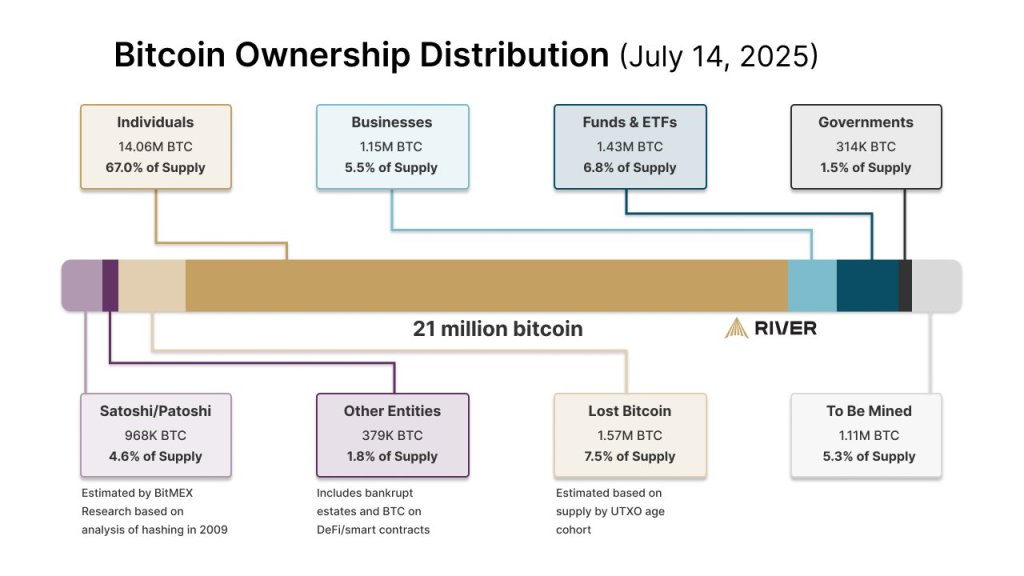
Financial services firm River has published a “Bitcoin Ownership Distribution” snapshot dated July 14, 2025, illustrating how the 21 million bitcoin supply is allocated across distinct holder classes. River accompanied the graphic with the statement: “The people had 15 years to front-run Wall Street on Bitcoin. Now big business is starting to catch on, but they’ll have to pay up to get their share.” Analyst TFTC added: “67% of Bitcoin is still owned by individuals. Wall Street, governments, and corporations? Just 13.8%.”

Who Really Owns Bitcoin?

According to River’s visualization, individual holders remain the dominant base, controlling 14.06 million BTC, or 67.0% of total supply. Institutional and state-linked ownership is far smaller in aggregate: businesses hold 1.15 million BTC (5.5%), funds and exchange-traded funds control 1.43 million BTC (6.8%), and governments account for 314,000 BTC (1.5%), for a combined 13.8% across those “Wall Street, governments, and corporations” categories.

The chart disaggregates several additional buckets. A “Satoshi/Patoshi” tranche of 968,000 BTC—4.6% of supply—is attributed to early mining activity (“estimated by BitMEX Research based on analysis of hashing in 2009”). “Other Entities” comprise 379,000 BTC (1.8%), a classification that includes bankrupt estates and BTC locked in DeFi/smart contracts. River also identifies 1.57 million BTC (7.5%) as “Lost Bitcoin,” an estimate based on UTXO age cohorts, and 1.11 million BTC (5.3%) “To Be Mined,” representing the unissued portion of Bitcoin’s fixed cap.
Bitcoin ownership distribution

Each percentage in the image sums to a complete distribution across current holders, lost coins, and the remaining unmined issuance. By separating lost supply, unmined coins and the early Satoshi/Patoshi cluster from active market participants, the data emphasize the scarcity available for new institutional accumulation and underpin River’s framing that “big business” must “pay up” to acquire meaningful exposure.

Recent market structure reinforces that message. Corporate and fund participation has accelerated in 2025, with new “Bitcoin treasury” vehicles, US spot exchange-traded products and specialist firms emerging to intermediate balance-sheet allocations.

Government participation, although a small slice in River’s methodology (314,000 BTC), is led by the United States and other jurisdictions holding or managing seized or strategically acquired coins. Independent trackers such as Bitbo/Arkham list the largest national holdings as the United States (about 198,000 BTC), China (roughly 194,000 BTC), the United Kingdom (around 61,000 BTC), Ukraine (about 46,000 BTC) and Bhutan (just over 11,000 BTC).

Differences between River’s aggregate government figure and higher third-party tallies reflect divergent classification methods—some datasets include broader seized balances or additional addresses not counted in River’s narrower “governments” bucket. River thinks that the Chinese government only holds 15,000 BTC that was recovered from the Plustoken scam in 2019.

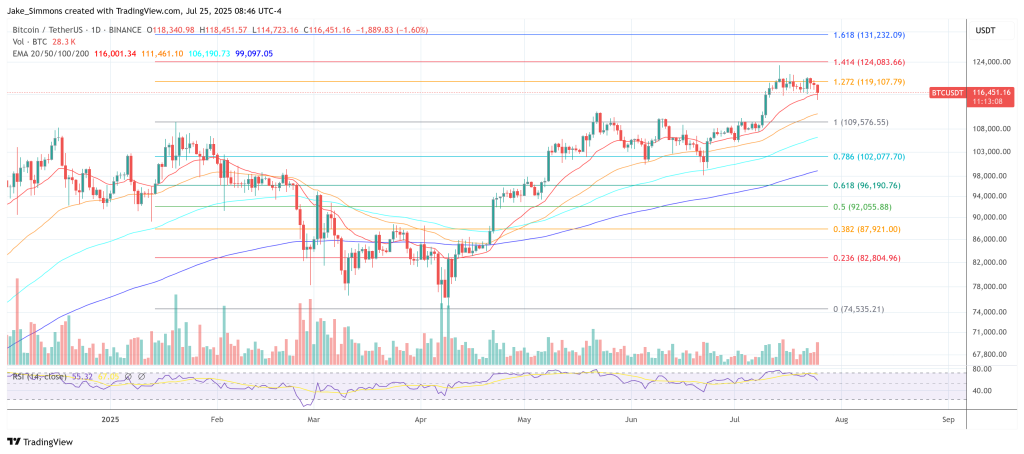
At press time, BTC traded at $116,451.
Bitcoin price

from Bitcoinist.com https://ift.tt/apnlqfj

Comments

Popular posts from this blog

Dogecoin Sees 47% Spike In Active Addresses, Why Price Could Follow Suit

Dogecoin has witnessed a massive spike in its active addresses , providing a bullish outlook for the foremost meme coin. Based on this development, the DOGE price could also witness a bullish reversal soon enough as it reclaims key support levels.  Dogecoin Records 47% Spike In Active Addresses In an X post , crypto analyst Ali Martinez stated that Dogecoin’s network activity is picking up. This came as he revealed that active addresses have jumped 47% in the past month, rising from 110,000 to 163,000. This development is bullish as it indicates more users are using the network.  This could help spark a significant rally in the Dogecoin price, as a surge in active addresses indicates that DOGE’s utility is on the rise. Another onchain metric which paints a bullish picture for the meme coin and hints at a reversal is the increase in new addresses. In another X post, Martinez revealed that Dogecoin’s new addresses have doubled in the past month, climbing from 16,400 to 34,6...

Bitcoin ETFs Post Second Straight Week Of $500 Million Outflow — Details

The US-based spot Bitcoin ETFs (exchange-traded funds) recorded their second consecutive week of significant outflows over the last five-day trading period. This recent run of disappointing performances reflects the ongoing shift in investor sentiment in the United States. Over the past year, strong inflows into the US Bitcoin ETF market have constantly been associated with positive action for the BTC price. Fittingly, the price of Bitcoin has been consolidating over the past few weeks, struggling to pick up any real momentum. Bitcoin ETFs Record Fourth Consecutive Outflow Day According to the latest market data , the US Bitcoin ETFs registered a total daily outflow of $62.77 million on Friday, February 21. This latest round of withdrawals marked the fourth straight day (and the eighth day in the last nine trading days) that the crypto-based products would witness a net capital outflow. The Grayscale Bitcoin Trust (with the ticker GBTC) accounted for a larger percentage of Friday’...

Bank of Russia Proposes Limited Crypto Trading for Select Investors

The Bank of Russia has put forward a new proposal that could mark a significant shift in the country’s approach to cryptocurrency regulation. Earlier today, the central bank announced that it has submitted a proposal to the Russian government to discuss allowing a limited group of investors to buy and sell cryptocurrencies such as Bitcoin. The proposal suggests implementing a three-year experimental regime where only qualified investors with at least $1.1 million in securities and deposits would be permitted to engage in crypto trading. This move is part of ongoing efforts to define Russia’s digital currency policies, which have historically shifted between strict regulations and cautious acceptance. Despite considering this controlled legalization for select investors, the Bank of Russia maintains its stance against using cryptocurrency as a payment method. The institution has also recommended introducing penalties for those who violate the terms of the experimental regime, rein...